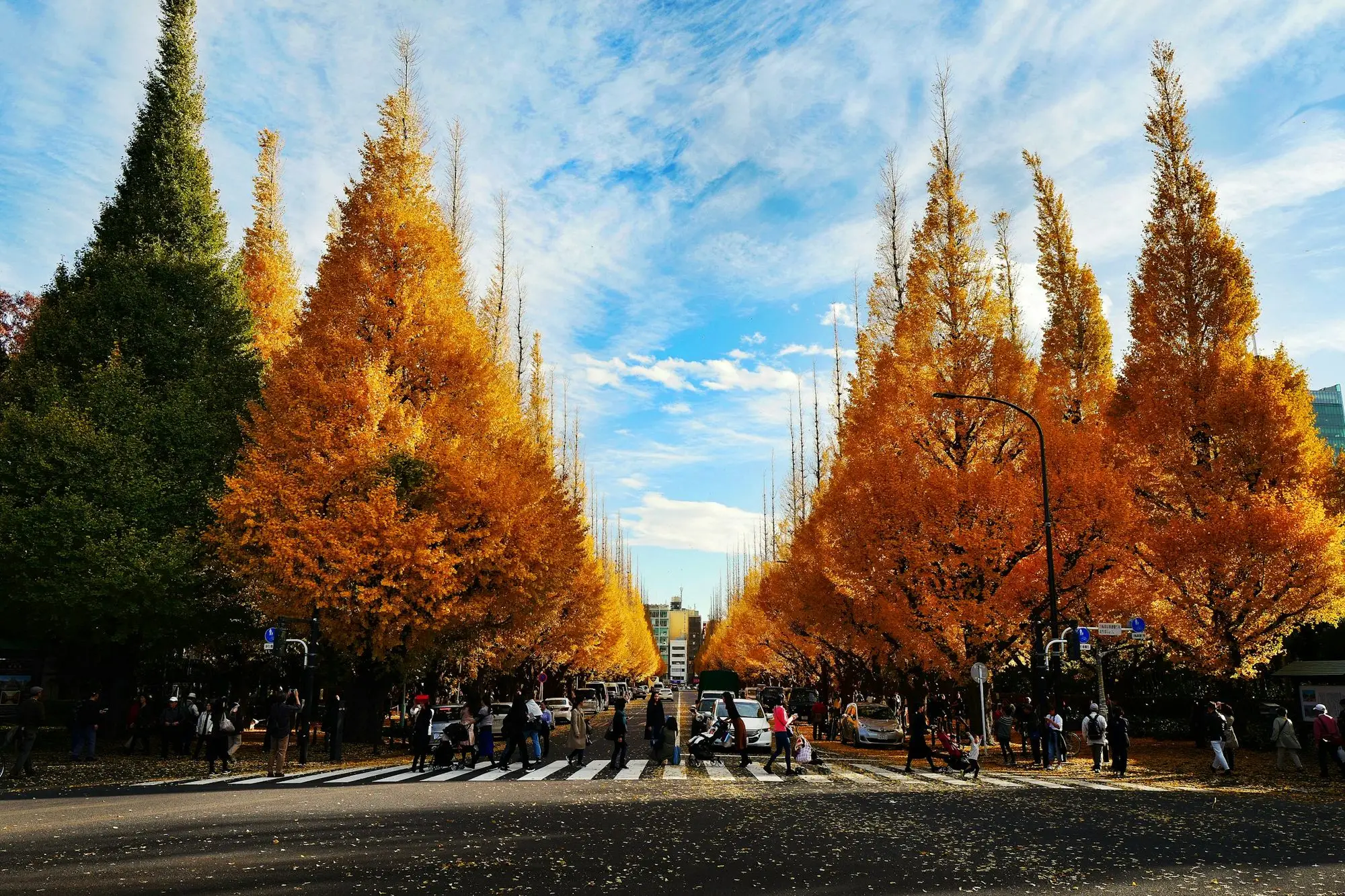
November is one of Tokyo's loveliest months: mild days, cool evenings and autumn colour in the parks. It's also a layering month, since early November can feel like late summer and the end of the month feels like winter is coming.
Japan is a long-haul trip for most readers, so check your long-haul airline's own cabin allowance. We still plan this capsule to the 40 × 30 × 20 cm box, so it also works on any budget hop to your departure hub and leaves room for shopping.
The weather in Tokyo in November
Shoulder months for comparison
| Station | October | November | December |
|---|---|---|---|
| Tokyo | 22.0 °C / 14.8 °C72 °F / 59 °F · 235 mm | 16.7 °C / 8.8 °C62 °F / 48 °F · 96 mm | 12.0 °C / 3.8 °C54 °F / 39 °F · 58 mm |
Source: WMO 1991–2020 climate normals, published by NOAA National Centers for Environmental Information (NCEI accession 0253808). Stations: Tokyo (WMO 47662). Normals are long-term averages, not a forecast. Sunrise, sunset and daylight are calculated for the 15th of the month in 2026 (local time). °F and inches are converted from the metric figures. “n/a” means the station doesn’t report sunshine in this dataset.
- Mild days, cool nights. Average highs are mid-teens and lows are high single figures, so you'll need layers rather than winter kit.
- Usually around 7 days with at least 1 mm of rain, but those days can be heavy. Pack a compact umbrella.
- Plenty of autumn sunshine, though sunset is around 16:30 in mid-November.
This week in Tokyo
The outfit plan in this guide is built from 30-year averages for November. This panel is the real forecast for the next 7 days, turned into packing tips for your cabin baggage.
The live forecast needs JavaScript. Everything else in this guide works without it, and the climate-based plan above covers any November trip.
Weather data from MET Norway (CC BY 4.0), adapted into packing tips.
 Karen’s tipWeather changes fast
Layer it up
Three thin layers from your capsule beat one thick coat in Tokyo in November: add or peel them off as the day changes.
- Base · next to skin
- Long-sleeve tee (short-sleeve for warm early-November days)
- Mid · warmth
- Cardigan, fine knit or merino half-zip
- Outer · wind and rain
- Packable light down jacket
☀ When it warms up: Afternoons can be mild and trains and shops are warm: the down jacket comes off.
🎒 Stash it: The down jacket packs into its pouch and fits in the foldable tote; the light scarf goes in a pocket.
Check the live “This week” forecast above for big swings between morning and afternoon.
We may earn a small commission if you buy through our links, at no extra cost to you.
Karen’s tip On the plane
- Wear your heaviest items on travel day: coat, knit and your bulkiest shoes. They’d take the most space and weight in your bag.
- Planes can be cold with the air con, so take a jacket on board.
- An inflatable cushion that packs into its own small, discreet pouch: a head cushion on the flight and a pillow on beach sunbeds. You choose how much air goes in, so it’s as firm or soft as you like, which a foam neck pillow can’t do.
More comfort tips for flying economy → · Is a lounge worth it? →
We may earn a small commission if you buy through our links, at no extra cost to you.
What locals actually wear
Sourced tips summarise or quote the linked source; anything marked editorial is our own advice. We don’t make up “local” style tips.
- Tokyo's official guide says early November can still feel like T-shirt weather, but you'll probably want a sweater and a jacket. The leaves start turning from late October.Source [1]: GO TOKYO (official Tokyo travel guide)
- A Tokyo-based contributor to LIVE JAPAN recommends layers instead of one heavy coat, topped with a packable light down or wind-resistant jacket like those from UNIQLO or MUJI.Source [2]: LIVE JAPAN (contributor Ms. Mentaiko, Tokyo-based)
- The same guide suggests natural autumn tones (green, off-white, beige) and says you can always buy extra layers in Tokyo if you get cold.Source [2]: LIVE JAPAN (contributor Ms. Mentaiko, Tokyo-based)
- Ginkgo colour peaks from mid- to late November. Hibiya Park, Meiji Jingu Gaien and Showa Kinen Park are recommended viewing spots.Source [2]: LIVE JAPAN (contributor Ms. Mentaiko, Tokyo-based)
3 outfit formulas
Your style: the best fit here is Relaxed sporty chic. Find your holiday style →
Ginkgo walk
- Packable light down jacket
- Long-sleeve tee plus a cardigan or fine knit
- Wide-leg trousers or jeans
- Comfortable trainers you can slip off
Tip: You may take your shoes off at some temples, traditional inns and restaurants, so wear easy slip-ons with neat socks.
City explorer
- Light wind-resistant jacket
- Merino half-zip
- Dark jeans
- Clean trainers
- Small crossbody bag
Tip: Trains and shops are warm, so take off your outer layer and carry it rather than overheating.
Izakaya evening
- Beige or off-white fine knit
- Midi skirt or tailored trousers
- Ankle boots or loafers
- Light down jacket and scarf for later in the month
Tip: Natural tones (beige, off-white, green) match the autumn look the LIVE JAPAN guide describes.
Swatches are a colour guide for each formula, not product photos.
Day to night in Tokyo
Same capsule, evening version: keep the base, swap one or two pieces. Every swap below stays cabin-bag friendly. How day-to-night swaps work →
01Ginkgo walk → izakaya evening
- Base (stays the same)
- Wide-leg trousers
- Light down jacket
- ☀ Day add-ons
- Long-sleeve tee and cardigan
- Trainers you can slip off
- ☾ Evening swaps
- Off-white fine knit instead of the tee and cardigan
- Flat loafers instead of trainers
- Small crossbody and a light scarf
Pieces added to your bag: 2, flat loafers (still easy to slip off) and a small crossbody.
02City explorer → rooftop bar
- Base (stays the same)
- Dark jeans
- Light wind-resistant jacket
- ☀ Day add-ons
- Merino half-zip
- Clean trainers
- ☾ Evening swaps
- Fine knit instead of the half-zip
- Statement earrings
- Light scarf
Pieces added to your bag: 1, statement earrings.
Karen’s tipChange your hair, change the look
Swapping my hair from up in the day to down in the evening (or the other way round) gives the whole outfit a different look. Even one piece of jewellery I didn’t wear earlier does the same.
💡 It’s a free trick, and it saves packing extra outfits.
We may earn a small commission if you buy through our links, at no extra cost to you.
Preview note: placeholder links to each shop’s normal pages, with no affiliate tracking yet.
What’s underfoot
The ground
- Smooth pavements, but huge stations with long corridors, stairs and transfers
- Compacted gravel shrine paths (e.g. the Meiji Jingu approach, about 700–800 m)
- Indoor areas where shoes come off (ryokan, temple halls, some restaurants and fitting rooms)
15,000–25,000 steps a day is commonly reported.editorial estimate
Trouble spots
- Shinjuku and other major terminals: long underground walks and stairs. Check the Tokyo Metro barrier-free maps for lifts
- Meiji Jingu: about 10–12 minutes on gravel from Harajuku
- Shoes-off entrances: you'll be repeatedly removing and putting on shoes
☀ Day shoes
Cushioned, broken-in trainers that slip on easily (elastic laces or a heel loop). Wear clean socks without holes.
☾ Evening shoes
Smart slip-on loafers or clean minimalist leather trainers, which work from day to night. Tokyo evenings are casual-smart.
✕ Leave at home
Lace-up boots that are slow to remove. Heels for station-heavy days.
Season notes: Mild to cool and mostly dry. Light trainers are fine, and no winter boots are needed.
Karen’s tipHeels and cobbles don’t mix. Check the ground before you pack heels: thin heels catch between cobbles, so a wedge or block heel is steadier for evenings.
One pair, day to night: The best space-savers are a sleek waterproof leather ankle boot (Paris, London, Vienna & Prague, Amsterdam, Rome in December), a clean minimalist leather trainer or slip-on loafer (Tokyo, London), and a low block-heel sandal (cruise). Travel day: wear the heavier pair (see On the plane). Break in shoes before the trip.
We may earn a small commission if you buy through our links, at no extra cost to you.
Sources: tokyometro.jp · cht.kokusen.go.jp · nippon.com · cooljapan-videos.com · japanbooked.com. Shoe recommendations are our own editorial advice based on these sources, checked 20 Oct 2026.
The free baggage packing list
Your bag: 40 × 30 × 20 cm
Planned for 5–6 nights, using a soft backpack of about 20–24 litres made to the 40 × 30 × 20 cm size. The rule that makes it work: wear your bulkiest items on the plane. The dotted outline is easyJet’s bigger free bag.
Wear on the plane worn
In the bag 12 items
Karen’s tipRoll, don’t fold. I roll my clothes, stuff socks and small bits inside my shoes, and keep socks in a clear bag that comes home full of dirty laundry or wet swimming costumes. How I pack →
Karen’s tipPack a bag in a bag.A foldable shopping bag that folds into its own little pouch, for shopping, dirty laundry and pool towels. It saves buying a bag abroad.Why, and where to get one →
- A heavy winter coat
- Lace-up boots (annoying when shoes come off)
- Too many tops (leave room for shopping)
Liquids: going vs coming home
UK airports vary. Heathrow, Gatwick, Birmingham, Bristol, Edinburgh, Belfast International, Belfast City, Bournemouth, Southend allow containers up to 2 litres; most others, including Manchester, Stansted and Luton, are still 100 ml.
- 100 mlTokyo Haneda (HND), in a 1 L clear bagto re-check
- 100 mlTokyo Narita (NRT), in a 1 L clear bag
Pack your liquids to 100 ml for the whole trip.
Karen’s tipWater bottle: keep it full through a 2-litre UK airport, or take it empty through a 100 ml one. Flying home: Tokyo Haneda, Tokyo Narita are 100 ml, so empty it and refill airside.Check your airport →
Karen’s tipDecant, don’t buy mini. I decant sun tan lotion into clear 100 ml spray bottles, and my day cream, night cream and cleanser into one squashy three-section silicone pot for trips of up to 4–5 days (separate pots if longer). Far cheaper than minis. How to do it →
Karen’s tip Check your room first
Read the hotel, Airbnb or hostel listing, or message the host, and ask whether they provide:
- Iron or steamer
- Hairdryer
- Toiletries: shampoo, shower gel (conditioner often isn’t supplied)
- Towels, plus beach or pool towels
- Washing machine or laundry service
- Plug adapters or USB sockets
- Kettle, tea and coffee
- Slippers and a robe
- A safe
Hostels often don’t provide towels or padlocks.
Karen’s tip Bring your own hair products. Most hotels supply shampoo but often not conditioner. Decant favourites into leak-proof travel bottles under 100 ml (fill them about ¾ full), or switch to solid bars, which don’t count as liquids. Amazon UK: Lericttor 100ml Silicone Travel Bottles ↗Check price · Amazon UK: Friendly Soap Travel Bar 95g (hair & body) ↗£4.72, price checked 20 Oct 2026 Every item they provide is one you don’t carry.
Karen’s tip No-iron packing
Pick fabrics that don’t crease. Woven cotton and linen crease; knits, merino, jersey and most polyester blends barely do.
- Hang creased clothes in the bathroom while you shower.
- Pack a small crease-release spray under 100 ml (it counts as a liquid).
- Roll clothes, and keep crease-prone pieces in a packing cube on top, not in a vacuum bag.
- Check whether your hotel or Airbnb has an iron.
Karen’s tip Buy it there?
Adding a checked bag typically costs around £60–80 return on a budget airline. So if your bag is full, buying bulky or liquid items when you arrive is often cheaper.
Think sun cream, full-size shampoo, insect repellent, a beach towel or flip-flops.
Yes in this destination: Convenience stores and drugstores are everywhere, and travel-size toiletries are easy to find.
Tick items off as you pack (your ticks aren’t saved). Liquids rules depend on your departure airport and change from time to time. Check your airport’s current security rules before you decant your toiletries (see liquids rules by airport).
Flying there on Ryanair, easyJet or Wizz?
- On a long-haul flight, check your airline's own cabin allowance. It's usually bigger than a budget carrier's free bag, but basic fares vary.
- Starting with a budget hop on Ryanair or Wizz Air to your long-haul hub? This capsule fits their 40 × 30 × 20 cm free under-seat bag.
- Leave space: Tokyo is a shopping city, and the foldable tote is your souvenir bag on the way home.
Duty-free bag: Ryanair: extra bag allowed · easyJet: extra bag allowed · Wizz Air: extra bag allowed. It still has to fit under the seat or in a locker, and gate staff decide. Duty free and your free baggage →
Sizes come from each airline’s official page (see our free baggage reference for links). Rules change, so check your booking before you fly.
Baggage picks
The ticks compare each bag’s stated outer dimensions with each airline’s free-bag size. A struck-through name means the bag is too big for that airline. Soft bags squash a little; hard cases don’t. We haven’t tested these bags ourselves yet.
Want to fit more in? Compression cubes and packing cubes that store more in a free bag →
Pieces that fit the formulas
- M&SM&S Feather & Down Padded Puffer Jacket£68 · checked 20 Oct 2026
- QuinceAustralian merino wool half-zip sweater
- QuinceCotton modal relaxed long-sleeve tee
- QuinceStretch high-rise wide-leg jeans
- QuinceCashmere scarf
- M&SM&S Umbrella with Windtech£12 · checked 20 Oct 2026
- M&SM&S Set of 3 Packing Cubes£12 · checked 20 Oct 2026
We may earn a small commission if you buy through our links, at no extra cost to you. Prices are shown only where we confirmed them on the retailer’s page (checked 20 Oct 2026); otherwise check the current price.
Sources
- Tokyo weather, GO TOKYO (official Tokyo travel guide)
- Visiting Tokyo in Autumn: Travel, Clothing & Weather Guide, LIVE JAPAN (contributor Ms. Mentaiko, Tokyo-based)
Airline free-bag sizes: see the free baggage reference. Climate: see the source under the weather table. Live forecast: weather data from MET Norway (CC BY 4.0), adapted into packing tips. Photos: Unsplash, credited on each image and on the photo credits page. Last checked October 2026.